





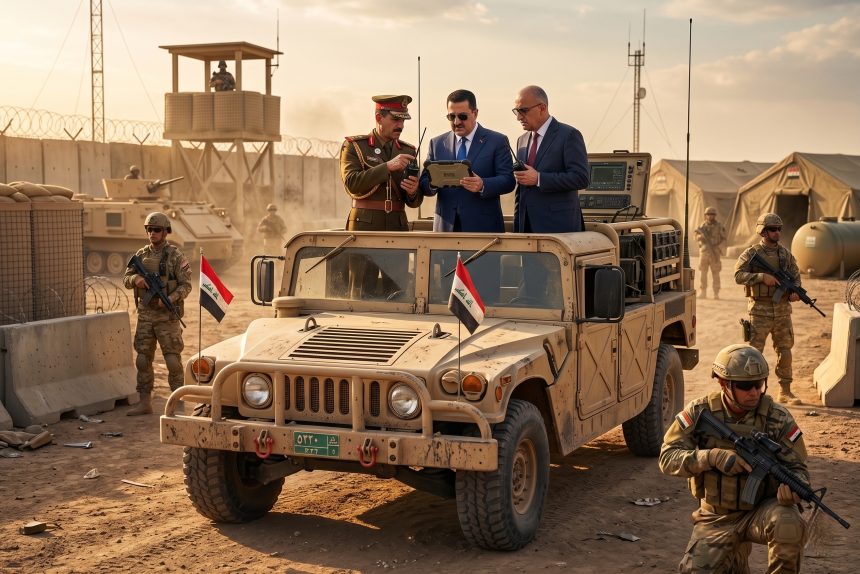
The stark, unforgiving desert stretching between Najaf and Karbala became the stage this week for a crucial geopolitical performance, as Iraq’s military sought to dispel the specter of a secret Israeli military base operating on its soil. This drama, fueled by reports in Western media and set against a backdrop of escalating regional conflict, lays bare the fragility of Iraqi sovereignty and the nation’s increasing vulnerability to the machinations of its powerful neighbors.
The Allegation and the Denunciation
The initial claims, notably published by the Wall Street Journal, suggested that Israel had established a “logistical hub” deep within the Iraqi desert to support its ongoing conflict with Iran. The implication was clear: Iraq, already a tinderbox of competing interests, was being used as an undeclared forward operating base by a major foreign military power—a profound violation of its territorial integrity.
On Tuesday, Baghdad’s response was swift and theatrical. Gen. Abdul-Amir Yarallah, Chief of the General Staff, personally led a contingent of forces and journalists to the alleged site. Standing amidst the barren landscape, he delivered a forceful denunciation, dismissing the reports as politically motivated “misinformation.”
“All what has been said by the Israeli and American media that there is an Israeli base — it is here in front of you,” Yarallah stated, acknowledging only the briefest of incursions. “We believe it was a small force that came and stayed for no longer than 48 hours.”
The Analogy of the Tipping Point
The current episode acts as a modern-day iteration of the “Great Game,” not a competition over colonial routes, but a struggle for geopolitical leverage in the Middle East. Iraq is no longer merely a battlefield; it is the geopolitical equivalent of a shared backyard, where regional rivals—Iran, Israel, and the United States—feel entitled to set up temporary camps or proxies, fundamentally disregarding the homeowner’s (Iraq’s) authority.
This denial, while necessary for Baghdad to maintain internal legitimacy and diplomatic standing, highlights a tragic political reality: Iraq can only deny the long-term presence of a foreign military, not the short-term use of its territory.

Acknowledging the Incursion: A Fatal Concession
Crucially, Iraqi officials did not deny an incursion took place. Maj. Gen. Tahseen al-Khafaji, spokesperson for the defense ministry, confirmed receiving intelligence about a “small enemy force” in the desert in early March.
The most damning detail of this brief encounter was the military’s subsequent attempt to investigate, which was met with aerial force. “Within 25 kilometers, the force which went there faced an aerial attack, which led to the martyrdom of one of our fighters and injured two others,” al-Khafaji recounted.
This sequence of events is a stark admission of powerlessness. A sovereign nation’s security forces were repelled, not by terrorists or insurgents, but by an unidentified, highly sophisticated aerial strike while performing their duty on their own soil. This incident is less a debate over whether a base existed and more an alarming revelation of who truly controls Iraqi airspace and territory.
Political Commentary: Sovereignty on Life Support
The political subtext of this incident is deeply troubling. The Iraqi government, led by Prime Minister Mohammed Shia al-Sudani, is walking a tightrope, attempting to assert domestic control while balancing powerful, often contradictory, foreign alliances.

- Internal Legitimacy: By forcefully denying the base and showcasing its forces on site, Baghdad seeks to reassure its domestic audience, particularly Shia factions and armed groups that view any Israeli presence as an intolerable provocation. The official narrative is a defense of national dignity.
- Regional Conflict Spillover: The incident unfolded days after the U.S. and Israel launched coordinated strikes against Iran. This timing suggests that the Iraqi desert was used as a potential staging or observation post during a critical escalation phase. Baghdad’s inability to prevent such use makes it an unwilling accomplice in the regional war.
- The Fading Ghost of Control: For years, Iraq has struggled to contain the activities of various Hashd al-Shaabi (Popular Mobilization Forces) and other proxies. Now, the challenge is amplified: not only must it control domestic non-state actors, but it must also physically contest the unannounced, temporary presence of powerful state actors. The Karbala desert incident signals that, despite the military’s assertions, Iraqi sovereignty remains severely compromised, treated merely as a convenient vacuum in the grand scheme of Middle Eastern power politics.
The mystery of the “Israeli base” may be resolved—no permanent installation exists—but the deeper political crisis endures. Iraq is less a sovereign nation and more a porous zone where the region’s most explosive conflicts can spontaneously erupt, leaving its own soldiers to pay the ultimate price.