






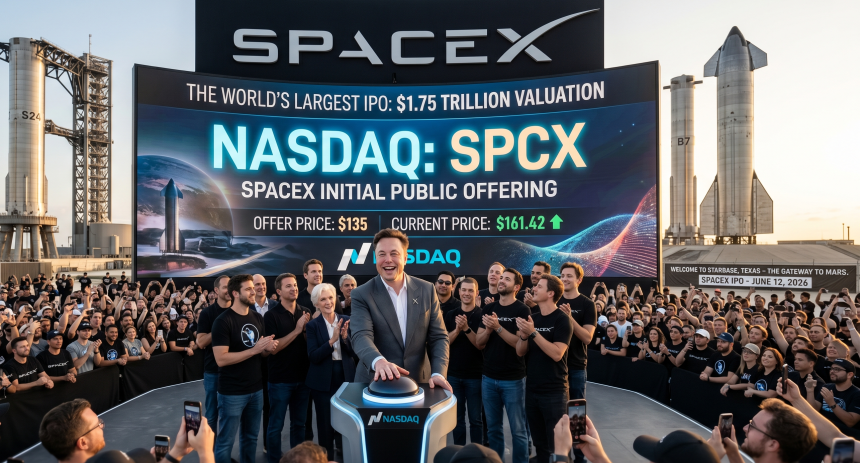
In a historic shift for global markets, Elon Musk has become the world’s first trillionaire, a milestone propelled by the blockbuster stock market debut of his aerospace company, SpaceX. His net worth has now reached approximately $1.11 trillion, a figure that rivals the entire economic output of nations like Poland or Switzerland. A Market-Shaking Debut
The surge follows SpaceX’s listing on the Nasdaq, which entered the market with a valuation of $2.2 trillion. While shares were initially priced at $135, investor demand sent them soaring to an intraday high of $176.50, before settling at $161 at the close of trading on Friday. The initial public offering (IPO) successfully raised $75 billion, highlighting an unprecedented level of investor enthusiasm for space-related enterprises.
Musk, who maintains a 42% ownership stake in the company, now holds a portfolio that includes approximately $767.1 billion in SpaceX equity, supplemented by significant holdings in Tesla. The Cost of Innovation
Despite the market fervor, financial analysts remain divided over the company’s valuation, which is built on optimistic projections rather than current profitability. SpaceX reported losses exceeding $9 billion between 2025 and 2026, driven largely by heavy investment in AI infrastructure and the development of reusable rocket technology.


The company’s roadmap—which includes ambitious concepts like a “lunar economy” and data centers in orbit—is viewed by some investors as a high-stakes gamble. Nancy Tengler, head of Laffer Tengler Investments, described the AI business segment as a “cash incinerator” but maintained that long-term investors are looking at a three-to-ten-year horizon. A Polarizing Figure
Musk’s record-breaking wealth has reignited international debates regarding economic inequality and political influence. His recent involvement in global politics has drawn both praise and intense criticism:


- Political Spending: Musk donated significant funds to President Donald Trump’s re-election campaign and previously led the Department for Government Efficiency (Doge), where he oversaw deep cuts to government spending, including the shuttering of the US Agency for International Development (USAID).
- Controversy and Criticism: Research published in the Lancet medical journal has raised concerns that these drastic funding cuts could potentially lead to over 14 million additional deaths by 2030.
- Global Friction: Musk has frequently clashed with international leaders, including UK Prime Minister Sir Keir Starmer, often over sensitive topics such as immigration and social division.
Investor Outlook
While the “trillionaire” label provides a powerful narrative, Musk’s wealth remains tied to volatile equity markets. He is restricted from selling his SpaceX shares for at least one year, and investors remain cautious about the long-term impact on diversified pension pots and index funds that now include SpaceX.
“The question on SpaceX is less about the immediate trading after IPO,” noted Samel Kerr, head of equity capital markets research for Mergermarket. “It’s more about how the price holds over the longer term”.
The financial projections surrounding SpaceX present a complex picture, contrasting the massive market optimism with the company’s actual performance data.


Here is an elaboration on the financial dynamics driving the current valuation and the risks involved:
- Valuation vs. Profitability: The company’s $2.2 trillion market valuation is not currently supported by its balance sheet. Instead, it relies on future-focused, highly optimistic projections rather than current earnings. SpaceX reported losses of over $9 billion between 2025 and 2026, creating a significant gap between market sentiment and fundamental performance.
- High-Cost Innovation: The core driver of these losses is the intense capital expenditure required for long-term R&D. This includes:
- AI Infrastructure: Massive spending to build out capabilities necessary for the company’s data-heavy goals.
- Next-Gen Tech: Development costs for advanced, reusable rocket technology, which remains a high-risk, high-reward endeavor.
- The “Lunar Economy” & Orbital Data Centers: SpaceX’s long-term business plan includes establishing a “lunar economy” and deploying data centers in orbit. While visionary, these concepts are currently speculative. Because they do not yet generate reliable cash flow, they are viewed by some analysts as a “cash incinerator”—a term used by Nancy Tengler to describe the AI business segment specifically.
- Long-Term Investor Horizon: Because the company is currently burning cash rather than generating it, the investment case is predicated on a “three-to-ten-year horizon.” Investors purchasing at the current valuation are essentially betting that these experimental business lines (orbiting data centers, space-based services) will eventually scale to become highly profitable, dominant industries.
Investment Risk Profile: SpaceX Market Outlook
Prospective investors should carefully consider the significant gap between SpaceX’s $2.2 trillion market valuation and its current financial performance. The company’s valuation is heavily weighted toward future, optimistic projections rather than present-day profitability, evidenced by reported losses exceeding $9 billion between 2025 and 2026.
Key financial risks include:
- Heavy Capital Expenditure: Substantial funding is directed toward speculative, high-cost R&D, specifically in AI infrastructure and advanced reusable rocket technology.
- Speculative Revenue Streams: Long-term business models such as orbital data centers and a “lunar economy” remain unproven. Financial analysts have characterized these ambitious segments as ‘cash incinerators’ with no current reliable cash flow.
- Long-Term Horizon: The investment thesis for SpaceX is not rooted in immediate returns but rather on a three-to-ten-year growth horizon. Success relies entirely on the scaling of these experimental technologies into dominant, profitable industries.