





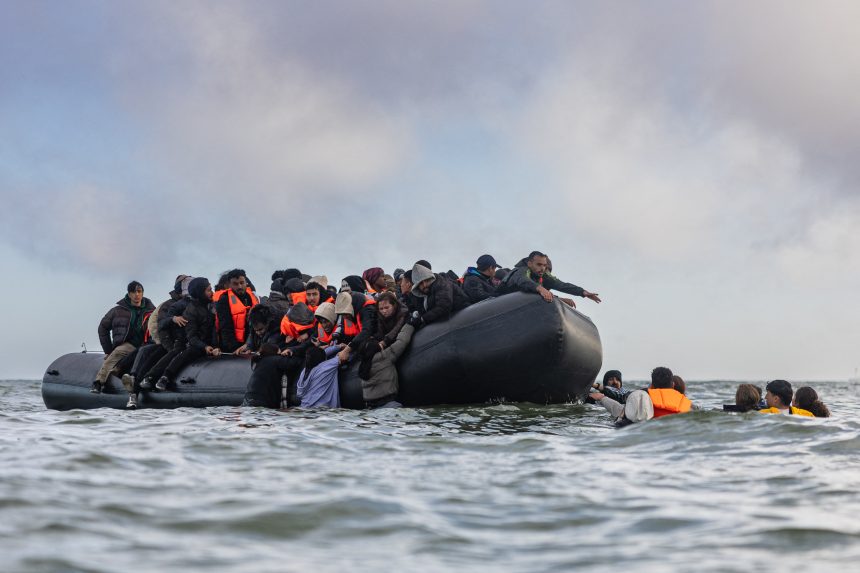
Two young Sudanese women suffocated to death on Sunday while attempting the perilous crossing from northern France to Britain in a small boat carrying more than 80 people, including pregnant women and children. This incident marks the third such tragedy in just over a month, highlighting a deadly cycle fueled by instability in the global south and restrictive Western immigration policies.
The victims, identified by officials as being of Sudanese origin and around 20 years old, were aboard a vessel that set out near Neuchâtel-Hardelot. A migrant aid association, Utopia 56, reported the victims as a 16-year-old child and a 20-year-old woman, adding that a pregnant woman aboard was also in critical condition.
Paulette Juilien-Peuvion, the mayor of Neuchâtel-Hardelot, expressed deep sorrow, saying, “We can’t see the end of this story. No one has the real solutions. And it’s tragic.”
The boat’s journey began during the night from Saturday to Sunday, but the engine failed, causing the vessel to drift. Seventeen people were rescued at sea. The remaining 65, along with the two deceased women, eventually ran aground on a beach. Authorities indicated that the women did not drown but most likely died from “suffocation, as unfortunately often happens” due to the extreme overcrowding. The mayor suggested they might have suffered cardiac arrest from being “crushed at the bottom of the boat.”
The Root Causes: A Crisis of Governance and Policy
The desperation driving migrants like these young Sudanese women is often rooted in the catastrophic governance failures across parts of Africa. Sudan, reeling from long-standing internal conflicts and a recent descent into civil war, exemplifies the political instability, economic stagnation, and human rights abuses that force citizens to seek safety and opportunity elsewhere. When African nations are unable or unwilling to provide security and hope for their youth, the resulting displacement becomes an inevitable global crisis.
This outward pressure meets the hard wall of Western immigration policy, which, critics argue, is riddled with hypocrisy. While Western nations often champion humanitarian ideals, their practical approach to migration is increasingly focused on deterrence and border militarization, epitomized by the recent Franco-British agreement.


Policy vs. Humanitarian Need
Three others on the boat suffered chemical burns from a mixture of fuel and seawater, and 14 more had minor injuries. An investigation has been launched to determine responsibility for the crossing.
However, migrant aid groups argue that the blame lies squarely with political choices. Utopia 56 stated that the “repressive policies at the Franco-British border are killing” and that these lives are “the result of political choices.” The group urged governments to “open the borders, establish safe routes for passage, and charter ferries.”
The deal signed last month between Britain and France pledges a significant increase in law enforcement personnel on the French coast, aiming to stop crossings. This move, while intended to curb illegal entries, is viewed by humanitarian organizations as a policy that simply makes the journey more dangerous, forcing people into smaller, more overcrowded, and less seaworthy vessels.
This tragedy follows two separate incidents in early April, where four migrants died off the French coast. In 2025, at least 29 migrants died at sea in the region.

The data underscores the scale of the challenge: British figures show 41,472 people reached the UK illegally in small boats in 2025. While French officials claim arrivals have been drastically cut this year, the ongoing death toll proves that as long as the underlying drivers of migration—the failures of leadership in the global south and the inhumane policy barriers in the West—remain unresolved, the Channel will continue to be a site of profound human tragedy.