







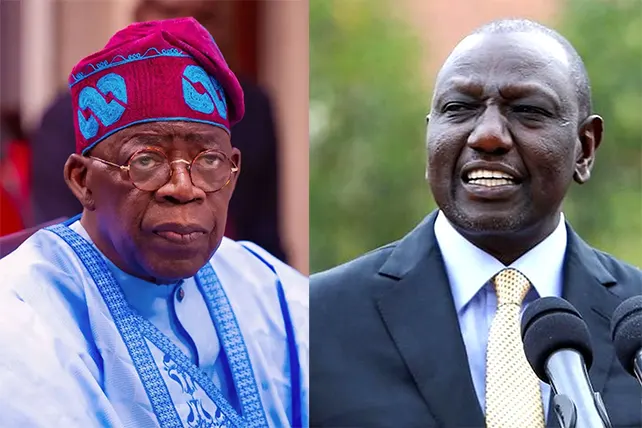
Nairobi, Kenya – Kenyan President William Ruto has issued a public clarification and apology, aimed at easing diplomatic tensions with Nigeria following controversial remarks he made about the Nigerian English accent. The President stressed that his earlier comments, which had been widely perceived as dismissive, were taken out of context.
Ruto faced significant backlash, particularly across social media, after comments he made while addressing Kenyans residing in Italy. During that address, he asserted that Kenyans spoke “the best English in the world,” and went on to suggest that the Nigerian accent could be difficult to understand, joking that a “translator” might be needed.
The remarks drew swift and sharp criticism from Nigerians and other Africans who felt the comments inappropriately elevated English proficiency—a relic of colonial influence—as a measure of national quality.
President’s Olive Branch and Explanation
Speaking on Tuesday, April 28, at the Mining Investment Conference and Expo in Nairobi, President Ruto extended an olive branch to Nigeria, whom he warmly referred to as “my in-laws,” a nod to his daughter’s marriage to a Nigerian citizen.
He used the platform to explain the origin of the controversial remarks, describing them as a “private conversation” with citizens abroad that was later made public and, he claimed, misrepresented.
“Please pass my regards, Minister, to President Tinubu, my friend, and to the great people of Nigeria, who are my in-laws, and do so in good English,” Ruto instructed a government official present at the event, before launching into his defense.


“I was speaking to my fellow citizens somewhere, and somebody, it was supposed to be a private conversation, but somebody decided that it should be public. But they also misrepresented the facts,” Ruto stated, eliciting laughter from the audience.
Highlighting Africa’s Linguistic Richness
The core of the President’s clarification was a reframing of his original intent. He maintained that his aim was not to demean Nigeria but to celebrate the strength of English proficiency across the African continent.
He argued that his remarks were part of a broader comparison meant to acknowledge that countries like Nigeria have developed strong and distinctive forms of the language. According to Ruto, the variation in accents should be viewed as a sign of linguistic richness, not a point of division or derision.
“The facts are that I was talking about how we in Africa speak very good English, all of us. In fact, in some countries like Nigeria, if you don’t speak excellent English, like the one we speak in Kenya, you may need a translator, you know, for you to understand the excellent English of Nigeria. So that was the comparison, but somebody decided to take it out of context,” the president elaborated.


Concluding his defence with a lighthearted appeal to Nigeria, he added: “But I think it is as well that we can have this conversation. And my in-laws, I hope there will be no consequences for whatever was done.”
Both Nigeria and Kenya, as former British colonies, utilize English as an official language, yet each nation has cultivated a unique, localized version shaped by indigenous languages and distinct cultural influences.