







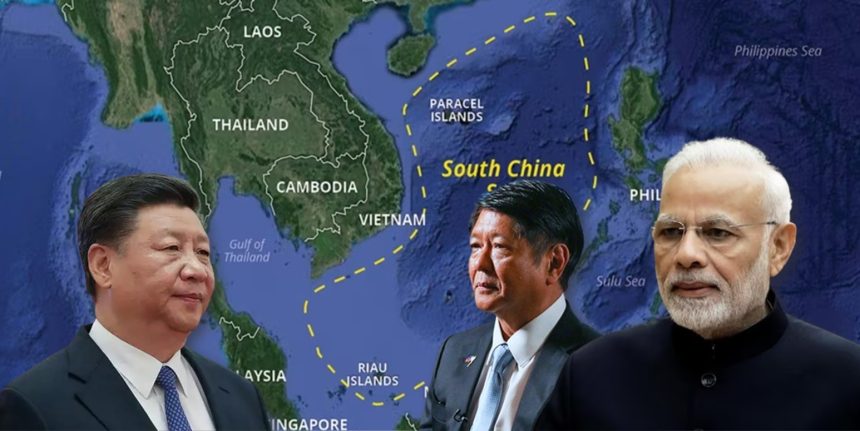
The South China Sea remains a crucible of escalating geopolitical tensions, embodying a complex interplay of territorial disputes, economic stakes, and strategic military posturing. Far from a localized maritime squabble, the dynamics in this vital waterway reflect the broader contest for influence between major global powers, primarily the United States and China, while simultaneously testing the resilience of international law and regional alliances.
The Core Dispute: Sovereignty and Strategy
At the heart of the conflict are overlapping sovereignty claims over key features—the Spratly Islands, the Paracel Islands, and various reefs and shoals—advanced by China, Vietnam, the Philippines, Malaysia, Brunei, and Taiwan. China’s assertion of its “Nine-Dash Line” claim, which encompasses roughly 90% of the sea, stands in direct contravention of a 2016 ruling by the Permanent Court of Arbitration (PCA) in The Hague, which invalidated Beijing’s historical claims. China’s outright rejection of this ruling is a profound challenge to the principles of the United Nations Convention on the Law of the Sea (UNCLOS) and has been interpreted by many regional observers as a move toward unilateral revision of the international maritime order.
China’s Strategy of ‘Creeping Assertiveness’
Beijing’s approach has been characterized by “creeping assertiveness,” utilizing a multi-pronged strategy to solidify its control without triggering a full-scale military conflict. This strategy includes:
- Militarization of Artificial Islands: Extensive land reclamation projects have transformed low-lying reefs into fortified military outposts equipped with runways, radar systems, and anti-aircraft missile batteries. These bases serve a dual purpose: projecting military power and extending surveillance capabilities deep into the region.
- The ‘Gray Zone’ Tactic: China frequently employs its Coast Guard and maritime militia—vessels often disguised as fishing boats—to harass and intimidate the fishing vessels and coast guard patrols of neighboring nations, particularly the Philippines and Vietnam. This avoids direct military confrontation (the “black zone”) but aggressively enforces Beijing’s claims, wearing down the resolve of smaller claimants.
- Economic Coercion: China leverages its massive economic footprint, offering substantial infrastructure investment and trade incentives to Southeast Asian nations while subtly penalizing those who overtly challenge its territorial claims. This often complicates unified opposition within the Association of Southeast Asian Nations (ASEAN).
The American Counterbalance: Freedom of Navigation and Alliances
The United States, while not a claimant, views the South China Sea as crucial to global trade and security. Approximately one-third of global maritime trade, valued at trillions of dollars annually, passes through its waters. The U.S. strategy is centered on maintaining “Freedom of Navigation Operations” (FONOPs), where U.S. Navy vessels deliberately transit near disputed features to challenge what it deems excessive maritime claims.
Strategic Realignments and Deterrence
Recent developments indicate a deepening of U.S. security commitments to its regional allies, particularly Japan, South Korea, and the Philippines. The revitalization of the Mutual Defense Treaty with the Philippines and increased access to Philippine military bases under the Enhanced Defense Cooperation Agreement (EDCA) are pivotal to Washington’s strategy of forward presence and deterrence. Furthermore, the Quadrilateral Security Dialogue (Quad)—comprising the U.S., Japan, India, and Australia—and the trilateral AUKUS security pact involving the U.S., U.K., and Australia, are increasingly focused on coordinating responses to China’s growing military capability in the Indo-Pacific theater.
Regional Dynamics: ASEAN’s Struggle for Unity
The ten-member ASEAN bloc is structurally challenged in formulating a unified response to the South China Sea issue. While all members value regional stability and freedom of navigation, their varied economic dependence on China leads to fractured diplomacy. Claimant states like Vietnam and the Philippines advocate for a strong, cohesive stance based on international law, whereas states like Cambodia and Laos, heavily reliant on Chinese investment, often dilute the group’s consensus. The slow pace of negotiations for a Code of Conduct (COC) in the South China Sea, which has dragged on for years, underscores the difficulty of achieving a legally binding and effective agreement under the current geopolitical pressures.



The Economic and Environmental Stakes
Beyond military strategy, the South China Sea holds immense value for its vast, though increasingly depleted, fishing grounds and its potential reserves of oil and natural gas. Competition for these resources often fuels the gray zone conflicts, directly impacting the livelihoods of millions of fishermen in the region. Moreover, the extensive dredging and construction involved in creating the artificial islands have caused catastrophic damage to the fragile coral reef ecosystems, raising serious long-term environmental security concerns.
Outlook
The trajectory of the South China Sea conflict appears set on a path of protracted tension. Absent a significant shift in Beijing’s policy or a successful, legally binding multilateral framework, confrontations—particularly the risk of unintended escalation between great power assets and regional coast guards—remain high. The key analytical focus for the coming years will be on the balance between China’s continued assertiveness and the capacity of the U.S. and its allies to enforce the principle of a rules-based international order in the region.