



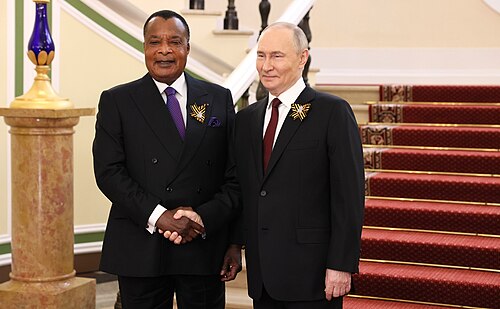
MOSCOW — Russian President Vladimir Putin met with Republic of the Congo President Denis Sassou N’Guesso at the Kremlin on Wednesday, promoting the potential for deeper bilateral ties, particularly in the economic realm.
The high-profile meeting immediately raises critical questions about Russia’s strategic objectives in Africa and whether this outreach echoes historical patterns of great power competition and neo-imperialism on the continent.
Putin was effusive, highlighting “promising” opportunities in areas including “geological exploration, energy, logistics, agriculture, and several other areas.” He offered his congratulations to the 82-year-old Sassou N’Guesso on securing a fifth term in office last month, a victory secured with almost 95 per cent of the vote in an election widely criticized for its lack of credibility.
The election’s circumstances—where key opposition leaders were jailed or in exile, and several parties boycotted the process—provide a stark backdrop to Moscow’s celebration of the Congo’s “stable political situation” and “good business prospects.”
A Question of Objectives
What is the true motivation behind Russia’s eagerness to court a regime often accused of repression and democratic deficits? For critics, such engagements appear less about mutual development and more about geopolitical maneuvering. By forging alliances with leaders whose legitimacy is contested domestically and internationally, Moscow gains access to crucial resources and international political support, often at the expense of democratic norms and institutional stability in the host nation.
Sassou N’Guesso, whose decades-long rule began in 1979, was quick to reciprocate Putin’s warm words. He stressed that “all the conditions” were in place for joint projects, noting the long-standing “relations of friendship, solidarity, and cooperation in all the fields including security, defence, and economy.”
This emphasis on security and defense is particularly revealing. Russia has increasingly relied on security cooperation, military aid, and the deployment of private military contractors to build influence across Africa, often filling vacuums left by receding Western powers or capitalizing on internal conflicts. While framed as a partnership, this approach frequently serves to entrench autocratic regimes, leading to accusations that Russia’s engagement constitutes a modern form of influence-seeking—a new imperialism cloaked in anti-Western rhetoric.
Putin concluded the meeting by praising Brazzaville’s cooperation on the international stage and inviting Sassou N’Guesso to the third Russia-Africa Forum later this year, signaling a further commitment to integrating the Republic of the Congo into Russia’s broader foreign policy architecture.