





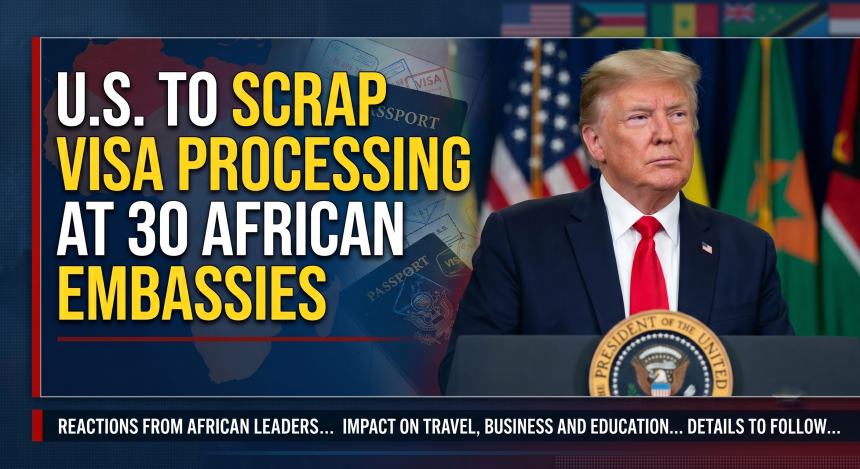
WASHINGTON, June 2—In a move that critics are defining as a definitive act of diplomatic hostility and an unvarnished display of discriminatory policy, the United States is set to slash visa-processing services across Africa by more than half, reducing the number of operational embassies from nearly 50 to just 20. This dramatic restructuring, reportedly approved by U.S. Secretary of State Marco Rubio, is not merely an administrative shift; it is a calculated barrier erected by an administration whose rhetoric has long framed Africans as undesirable, raising urgent questions about Africa’s continuing engagement with the West.
Institutionalizing the White Supremacist Agenda
This policy acts as the institutional confirmation of the aggressive immigration agenda that has defined President Donald Trump’s political career. The administration’s rhetorical objectives have been laid bare by Trump’s own reported comments describing African and Haitian nations as coming from “shithole” countries. The elimination of visa services at 30 embassies serves as a physical manifestation of this white supremacist-aligned policy, effectively discouraging and punishing African mobility.
By forcing applicants to travel potentially thousands of miles to new regional hubs—including Lagos, Nairobi, Accra, Addis Ababa, Dakar, Johannesburg, Cape Town, Kampala, Kigali, and Kinshasa—the US knowingly imposes massive financial costs and logistical nightmares on African citizens. The message is unmistakable: Africa is a continent whose vast resources are aggressively desired, but whose people are institutionally unwelcome. Geopolitical Whiplash: Contempt for People, Competition for Minerals
The cruelty of this anti-people policy stands in stark contradiction to the US’s simultaneous, aggressive push for influence and resources across the continent. Washington continues to leverage its diplomatic and economic muscle in a geopolitical scramble for Africa’s vital resources—including critical minerals essential for advanced AI and EV technologies—often through conditional aid packages that infringe on national sovereignty.
For African nations, this policy exposes a fundamental hypocrisy: the US frames its engagement as a “partnership” while pursuing a strategy that critics describe as “competitive extraction”. The recent impasse over a critical $1 billion U.S. health deal with Zambia, for instance, stalled over allegations that the framework attempted to link crucial funding to access to critical minerals and controversial data-sharing provisions. This demonstrates that U.S. “aid” is often a strategic economic tool designed to secure U.S. industrial and technological supply chains, placing national autonomy at risk. The Call for African Sovereignty: Time to Take a Stand

This aggressive reduction in consular services must serve as a critical moment of reflection for the continent. The visa cuts demonstrate a profound diplomatic disrespect for African citizens and sovereignty.
When US “partnerships” are conditional, attempting to dictate domestic policy and secure economic control, African leaders must ask themselves:
- Why should Africa continue to engage with a Western power that simultaneously restricts the movement of its people while aggressively pursuing its mineral wealth?
- What does sovereignty truly mean if essential health aid is leveraged as a punitive measure or as a backdoor for economic control?
- How long will the continent risk being “trapped between new, competing global rivals” when the West, especially the US, treats its people with such open contempt?
The continent’s growing assertiveness—seen in the demands from governments like Zambia and Zimbabwe for revisions to conditional terms in U.S. financing frameworks—must now accelerate. The US visa cuts are not just a diplomatic change; they are a clear directive for Africa to assert its agency, prioritize national interests, and take a unified stand against a West whose engagement is proving to be both conditional and deeply demeaning. The era of “unquestioning acceptance of development assistance is over”. Africa must respond to this institutionalized hostility by demanding mutually beneficial arrangements that prioritize its people and its full sovereign control.
Doo Media News Editorial