





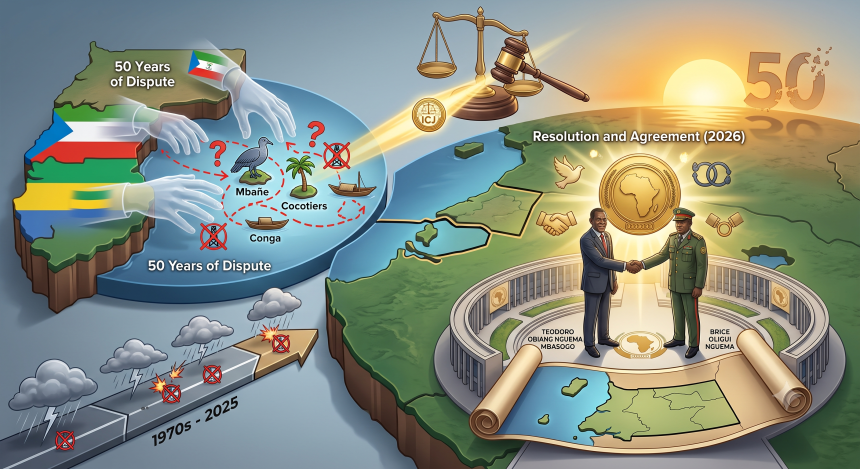
In a landmark diplomatic breakthrough, Gabon and Equatorial Guinea have officially signed an agreement on Tuesday, bringing an end to a protracted, half-century-long sovereignty dispute over three strategic islands in the Gulf of Guinea.
This development marks the conclusion of a contentious chapter involving the 30-hectare Mbanie island, alongside the smaller Cocotiers and Conga islets—territories that have remained points of friction since the early 1970s.
In May of last year, the International Court of Justice (ICJ) in The Hague delivered a definitive ruling, finding in favour of Equatorial Guinea. The recent signing ceremony, hosted at the African Union’s headquarters in Addis Ababa, saw Equatorial Guinean Foreign Minister Simeon Oyono Esono Angue and Gabon’s Constitutional Council head, Dieudonne Aba’a Owono, formalize their commitment to respect this ICJ mandate.
“This matter has been settled once and for all,” stated Minister Esono Angue, emphasizing a collective need for both nations to “move forward.” Echoing this sentiment, Aba’a Owono described the agreement as the catalyst for “a new era of cooperation.”
African Union Commission chairperson Mahmoud Ali Youssouf, a signatory to the accord, lauded the resolution of a border impasse that had lingered for far too long, inhibiting regional stability.
A Legacy of Colonial Cartography
The genesis of this dispute traces back to 1900, when European colonial powers France and Spain signed the Treaty of Paris, establishing territorial borders that were poorly demarcated. Decades later, Gabon contended that the 1974 Bata Convention superseded previous agreements, effectively cementing its sovereignty over the islands.

The crux of the international legal battle centered on the validity of these historical documents. The ICJ ultimately determined that the 1974 Bata Convention did not confer legal title. Instead, the court affirmed that sovereignty originated from Spanish colonial possession, which transitioned to Equatorial Guinea upon its independence in 1968.
While the islands themselves are minuscule and uninhabited, their location sits within a maritime zone suspected to hold substantial oil and gas reserves—a critical factor in the decades of diplomatic inertia.
Implications for Sub-Regional Stability and Geopolitics
The resolution of this stalemate serves as a vital stress test for the peace and security architecture of the Economic and Monetary Community of Central Africa (CEMAC). For too long, the dispute acted as a dormant volcano, occasionally erupting into diplomatic tensions that stifled deeper economic integration within the sub-region. By removing this territorial anchor, both nations may now pivot toward collaborative management of Gulf of Guinea resources, potentially unlocking shared prosperity rather than competing for fragmented maritime boundaries.
However, the endurance of this dispute also reflects the deeper, entrenched hegemonies that have defined political life in both countries for decades. The reliance on colonial-era treaties to determine modern-day sovereignty highlights a systemic failure of post-independence diplomatic transitions. Instead of prioritizing indigenous, consensus-based conflict resolution, leaderships in Libreville and Malabo frequently leveraged the dispute as a nationalistic rallying cry to consolidate domestic power.

Furthermore, this stalemate underscores the enduring shadow of imperialism. The conflict was not merely a modern oversight but a direct inheritance of arbitrary lines drawn by foreign powers—France and Spain—who prioritized colonial extraction over administrative clarity. The “failure of diplomacy” that allowed this dispute to fester for fifty years is also a critique of the international community’s sluggish intervention in matters where Western interests in oil and gas often took precedence over stable, regional power transitions. As the two nations turn this page, the path forward must involve moving past the vestiges of colonial demarcations to build a sovereign, integrated future that prioritizes the stability of the Gulf of Guinea over the ghosts of the past.