




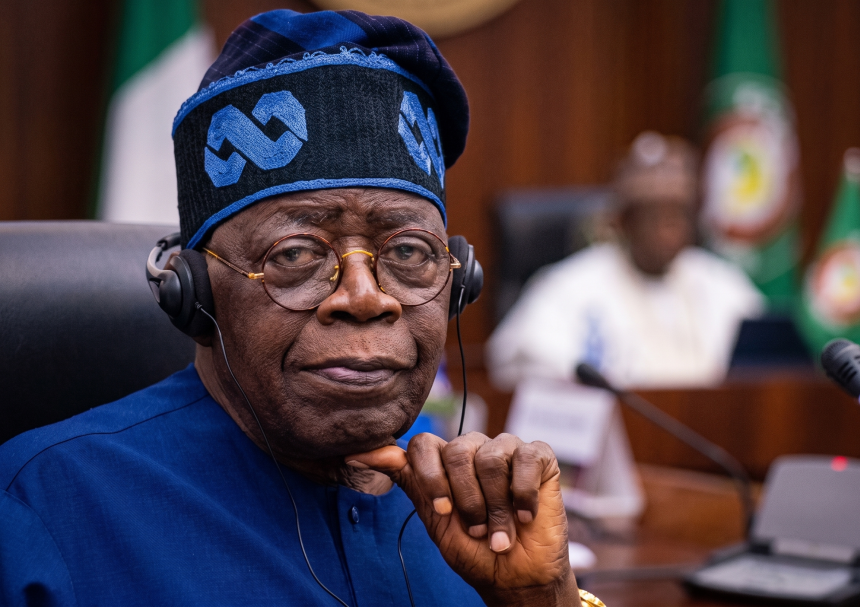
In a display of political stagecraft that mirrors a coronation more than a contest, President Bola Tinubu has secured his party’s mandate for the 2027 elections. Yet, beneath the veneer of “internal democracy” lies a nation grappling with a cost-of-living crisis that threatens to swallow the very mandate he seeks to renew.
ABUJA — In the heart of Nigeria’s capital, at a conference center conspicuously bearing his own name, President Bola Tinubu was officially “anointed” as the All Progressives Congress (APC) flagbearer for the January 2027 presidential race. The event, characterized by the party as a “landslide victory,” was less an electoral battle and more a bureaucratic formality. Facing only a single, obscure challenger—Stanley Osifo, whose 100-million-naira entry fee bought him little more than a front-row seat to his own defeat—Tinubu’s path was cleared with surgical precision.
This political maneuvering highlights a sharp, almost cruel analogy for the state of the Nigerian republic: the ruling party’s internal mechanics are operating with high-octane efficiency, while the engines of the national economy are seizing up. Tinubu’s penchant for decor featuring the number “eight”—a reference to his two-term ambition—serves as a constant reminder that for the political elite, the future is a pre-calculated certainty. For the average Nigerian, however, the future is an opaque struggle for survival.
The APC’s dominance is now nearly absolute, with the party controlling 31 of 36 states. This expansion, largely fueled by a wave of defections, suggests a political landscape where the opposition is not just weakened, but perhaps irrelevant. However, this consolidation of power stands in stark contrast to the fragmentation of the Nigerian dream. While Tinubu’s first term was lauded by international investors for “bold reforms,” the domestic reality has been a relentless assault on the middle and lower classes.
The Price of Reform: A Statistical Siege
The economic indicators under the Tinubu administration present a harrowing landscape. Since he took office, the poverty rate has climbed by four percent, leaving 60 percent of the population—over 130 million people—subsisting below the poverty line. Inflation, which peaked at a staggering 30 percent in 2024, remains a suffocating 15 percent, while fuel prices have quadrupled over the last four years. These are not merely statistics; they represent a total evaporation of purchasing power for the “ordinary Nigerian” the government claims to serve.

The “formality” of the APC primaries is emblematic of a broader political disconnect. There is a profound irony in a president securing an unchallenged path to re-election while the citizenry faces the most severe economic distress in a generation. It suggests a system where the machinery of power is insulated from the consequences of its own policies. The APC celebrates “internal democracy” in a vacuum, seemingly oblivious to the fact that democracy without economic dignity is a hollow shell.
A Divided Horizon
As opposition parties prepare for their own primaries in the coming days, they face a Herculean task. They are not merely running against a candidate, but against an institutionalized political monolith that has successfully merged the identity of the state with the identity of the party. The upcoming January 2027 election will be a referendum on whether political consolidation can withstand the pressures of a starving populace.
In the final analysis, Tinubu’s “landslide” within the APC is a victory in a closed loop. The real test remains outside the Abuja conference center, in the markets where food is unaffordable and at the pumps where fuel is a luxury. For the President, the path to re-election is a paved highway; for Nigeria, the path to recovery remains a treacherous, uphill climb.