




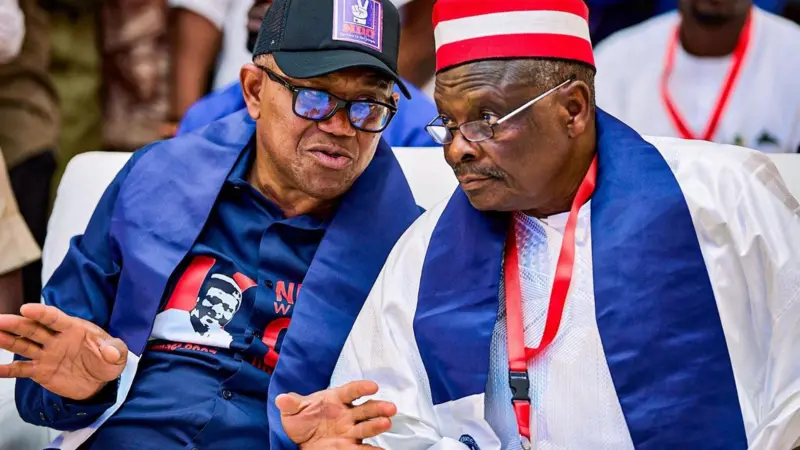
The Nigeria Democratic Congress (NDC) has officially zoned its presidential ticket to the Southern region of Nigeria for a single four-year term, a move that significantly boosts the presidential aspirations of former Anambra State Governor, Mr. Peter Obi.
The decision, adopted by delegates at the NDC National Convention in Abuja following a motion moved by Afam Victor Ogene (representing Ogbaru Constituency), immediately reshapes the contest within the party. Crucially, the resolution stipulates that following this four-year term, the ticket will automatically revert to the North.
The Obi Advantage and Southern Calculus
This zoning structure is a direct windfall for Obi, who has been a prominent national figure and strong voice from the South East. While the decision nominally opens the door for all Southern aspirants, Obi’s profile and existing political machinery place him as the immediate frontrunner, solidifying the narrative that the NDC is positioning itself to capitalise on the widespread desire for a Southern presidency, particularly one outside the established political duopoly.
The explicit commitment to a single four-year term for the South, followed by an automatic shift back to the North, is the most salient and arguably controversial aspect of this development.
Kwankwaso’s Strategic Endorsement: Unity or Calculated Retreat?
The immediate reaction from fellow presidential aspirant and former Kano State Governor, Rabiu Kwankwaso, was one of staunch support, delivered in a passionate speech at the Convention.
Kwankwaso hailed the NDC’s growth from a “bold movement” into a “formidable platform for national renewal” and dedicated a significant portion of his address to historic North-South alliances—citing the NEPU/NCNC partnership of 1954, the NCNC/NPC coalition of 1960, and the NPN alliance of the Second Republic.


Critical Analysis: NDC’s Southern Zoning and the Ambitions of Peter Obi
Key Takeaways from Kwankwaso’s Speech:
| Element | Kwankwaso’s Message | Critical Analysis |
|---|---|---|
| Zoning Support | “I support the decision to zone the presidential ticket of the NDC to the South, so that it allows the region to complete its turn in producing national leadership.” | A pragmatic, strategic retreat. By framing it as “allowing the region to complete its turn,” Kwankwaso aligns himself with the principle of federal character, positioning himself as a loyal party man willing to defer his ambition for the sake of unity. |
| Historical Context | Emphasised past North-South alliances (Azikiwe/Kano, Azikiwe/NPC, Shagari/Ekwueme). | A deliberate attempt to legitimise the current power-sharing arrangement by rooting it in Nigeria’s political history, underscoring the necessity of North-South cooperation for national leadership. |
| Core Promise | Pledges to prioritise “leadership without ethnic jingoism and religious favouritism” and restore Nigeria’s dignity. | Reaffirms commitment to visionary governance despite the zoning, ensuring his political relevance and appeal to a broad, non-regional base of supporters. |
The Critical Lens: Zoning as a Double-Edged Sword
While the zoning decision is presented as a mechanism for “true national healing” and adherence to federal character, political analysts observe a more complex, calculated gamble:
- Guaranteed Northern Reversion: The commitment to shift the ticket back to the North after four years is essentially a tacit agreement between the party’s major Northern and Southern blocs. This clause guarantees that the Northern bloc, led by figures like Kwankwaso, maintains a clear future path to the presidency, making the current Southern support more palatable. It suggests a focus on rotational power-sharing over meritocratic selection alone.
- Immediate Political Utility: The NDC is strategically leveraging the popular call for power rotation to the South to attract votes from the region, especially from the South East, where Obi commands significant grassroots support.
- Risk of Instability: Committing the party to a regional rotation structure for an eight-year cycle (four years South, four years North) risks alienating potential high-quality aspirants who may not fit the prescribed regional slot, potentially breeding internal division down the line. Furthermore, it embeds regional calculations deeply within the party’s core structure, possibly undermining the stated goal of leadership “without ethnic jingoism.”
In summary, the NDC’s decision is a masterstroke in political realpolitik. It secures the immediate future of the party by giving a clear path to its most popular Southern candidate (Obi) while reassuring the Northern power base (Kwankwaso) of a guaranteed chance in the subsequent cycle. The challenge now for the NDC is to market this power-sharing calculus as genuine national healing, ensuring that the focus remains on the “national renewal” Kwankwaso spoke of, rather than the arithmetic of rotation.