

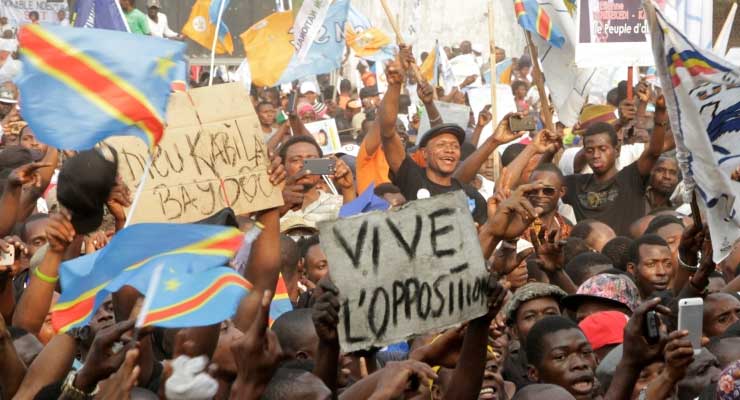
Kinshasa, DR Congo—The political temperature in the Democratic Republic of Congo is spiking following a recent march by supporters of the ruling party, the Union for Democracy and Social Progress (UDPS), which has intensified debate over US sanctions and a proposed constitutional reform. The opposition LAMUKA coalition is sharply criticizing the situation, labeling it a dangerous manifestation of a “two-tier democracy.”
The Double Standard on Protests
While acknowledging the UDPS’s right to demonstrate—as thousands recently did in Kinshasa to support US sanctions against former President Joseph Kabila—the opposition accuses President Félix Tshisekedi’s government of applying a stark double standard.
Prince Epenge, a spokesperson for LAMUKA, asserts that any opposition rally is routinely met with repression and violence. “There is nothing unusual about the UDPS demonstrating. What we denounce is a policy of double standards. Our demonstrations are violently repressed, with injuries and arrests,” Epenge stated.
Editor-in-Chief Commentary: The fundamental right to peaceful assembly is non-negotiable in any functioning democracy. If the government allows its supporters to march freely while systematically deploying force against its critics, the notion of equal political participation is hollowed out. This is precisely the kind of selective enforcement that breeds resentment and validates the opposition’s claim of a biased political environment.
Sanctions: A Temporary Win or Escalation?
The UDPS celebrated the recent US sanctions targeting Kabila, but the opposition warns that this external pressure will not solve Congo’s deep internal crisis—and could even destabilize the country further.
Epenge issued a direct warning to the current administration, suggesting that if President Tshisekedi proceeds with attempts to change the “rules of the democratic game,” he too could face international repercussions. “The UDPS’s joy will be short-lived if Mr. Félix Tshisekedi insists on changing the rules. The next sanctions could target him,” he cautioned.
The Specter of a Third Term
Ostensibly, the government claims its proposed legal adjustments are merely aimed at strengthening national sovereignty and fixing institutional dysfunctions. The opposition, however, sees this as a thinly veiled attempt to clear the path for Tshisekedi to seek a third term, a move currently blocked by the Constitution.
For the opposition, this proposed reform is a “red line” that signals a deeper crisis. “This is not a revision—Tshisekedi wants to tear up the Constitution,” Epenge declared. “It amounts to a constitutional coup. We will fight by all possible means. It will not succeed—the people are standing firm.”
Editor-in-Chief Commentary: Any attempt by a sitting president to alter term limits, especially under the guise of “institutional reform,” is universally viewed with suspicion across Africa. Such moves often undermine democratic transitions and prioritize the incumbent’s political survival over constitutional integrity. The fierce reaction from opposition leaders like Moïse Katumbi and Martin Fayulu suggests that this push for reform risks plunging the DR Congo into a prolonged period of severe political crisis.
Showdown Looms
In a direct challenge to the ruling majority, key opposition figures—including Moïse Katumbi, Martin Fayulu, and Delly Sesanga—are organizing a large demonstration set for the coming days.
Meanwhile, the ruling majority is actively pursuing its agenda, having already submitted a draft law for a constitutional referendum to the National Assembly. A major political confrontation, centered on the sanctity of the Constitution and the nature of Congolese democracy, is clearly taking shape and is expected to intensify in the weeks ahead.