





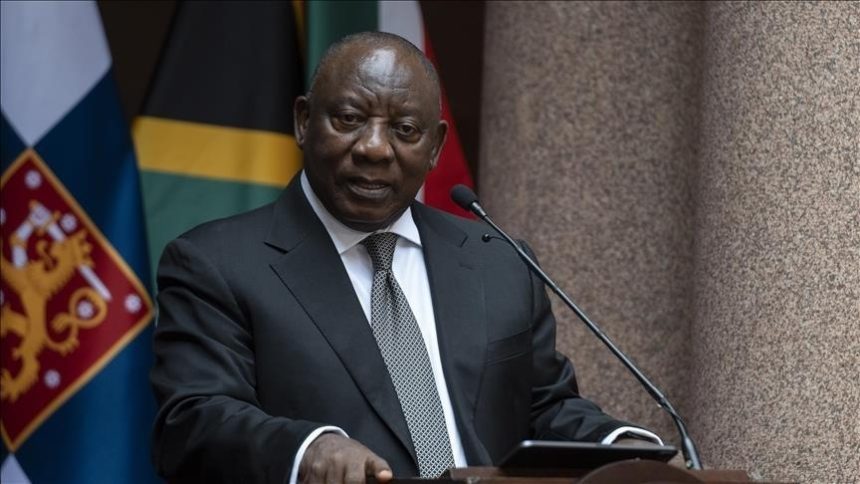
CAPE TOWN — South Africa’s political arena is ablaze, not with governance, but with the searing heat of scandal, as President Cyril Ramaphosa desperately clings to power amidst mounting, and arguably legitimate, opposition demands for his immediate resignation. The saga surrounding the alleged 2020 theft of undisclosed, and suspiciously large, amounts of foreign currency from his Phala Phala farm is no longer a mere question of misconduct; it has metastasized into a constitutional crisis threatening the stability of Africa’s most industrialized nation.
The spectacle witnessed during Ramaphosa’s recent parliamentary question-and-answer session was a clear indication that the political consensus has fractured. Opposition parties, recognizing the profound weakness and vulnerability exposed by the President’s actions—specifically, the alleged concealment of the crime from both police and tax authorities—are now aggressively pushing the narrative that Ramaphosa has fundamentally breached the public trust and the oath of his office. The dramatic walkout by opposition members was less a protest and more a calculated declaration that, under this cloud of suspicion, Parliament lacks the moral authority to function as normal.
The emergent MK party’s fiery demand for Ramaphosa to step down immediately highlights the depth of political acrimony. While Ramaphosa’s refusal to quit is predictable—a strategic retreat now would be an admission of guilt—it places Parliament in an untenable position. The Constitutional Court’s ruling last week, affirming the procedural necessity of referring the 2022 independent report to an impeachment committee, has effectively boxed in the legislature. It mandates a process that the President and his allies had hoped to sideline.
Crucially, the focus must now shift to the daunting political arithmetic. Impeaching a sitting president requires the support of two-thirds of the 400-member Parliament. This high threshold, while constitutionally sound, raises the unavoidable question: Will factions within the ruling party (ANC), perhaps driven by internal rivalries or simple political pragmatism in the face of damaging public sentiment, ultimately sacrifice Ramaphosa to save the party’s own electoral prospects?
As the multi-party impeachment committee begins its inevitable investigation—a process for which, tellingly, no timeline has yet been provided—the nation is left holding its breath. The delay is tactical; every day Ramaphosa remains in office is a day the opposition can leverage the scandal. This is no longer about a break-in; it is a high-stakes constitutional showdown testing whether South Africa’s institutional checks and balances can prevail against the political survival instincts of its highest office holder. The opposition is not just demanding accountability; they are demanding a seismic shift in power.