




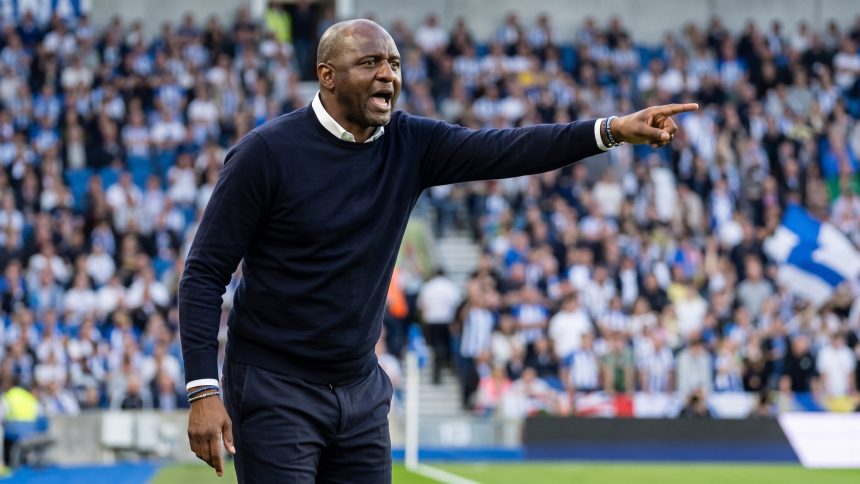
In a move that signals a bold new era for African football, the Senegalese Football Federation has appointed legendary former Arsenal captain Patrick Vieira as head coach, tasking the Dakar-born icon with resurrecting a national team reeling from World Cup heartbreak and the exit of Pape Thiaw.
Following a high-stakes emergency session, the Federation (FSF) hailed Vieira’s arrival as a “strategic pivot.” The objective is clear: to install a world-class technical foundation that mirrors the immense sporting aspirations of the reigning powerhouses of the continent.
The 50-year-old tactician steps into the void left by Thiaw, whose tenure ended abruptly after a bruising round-of-32 exit in Qatar, where a 3-2 extra-time collapse against Belgium dashed the dreams of a nation.
Born in the heart of Dakar in 1976 before moving to France as a child, Vieira’s career has been nothing short of cinematic. A titan of the game, he earned 107 caps for Les Bleus, playing a pivotal role in their historic 1998 World Cup and Euro 2000 double.


From Premier League Dominance to the Dugout
Vieira’s name is synonymous with the golden age of Arsenal. Over nine transformative years in North London, he secured three Premier League titles and famously captained the “Invincibles” to an undefeated season in 2003-04—a feat of leadership and resilience he now brings to the Lions of Teranga.
His illustrious playing path took him through Juventus, Inter Milan, and Manchester City, providing a masterclass in elite football before he transitioned to management with New York City FC in 2016.

While his coaching resume includes stints at Nice, Crystal Palace, Strasbourg, and Genoa, the Senegal job marks a watershed moment: his first venture into the high-pressure arena of international management.
The FSF is expected to unveil the full technical details of his contract and hold a formal presentation in the coming weeks as the nation prepares for his arrival.
Navigating a Stormy Inheritance
The task ahead is formidable. Vieira takes the reins of a squad still shadowed by the turbulence of the Thiaw era, which saw the team’s on-pitch success marred by institutional friction.
The lowest point came when Senegal’s 2025 AFCON victory was sensationally stripped by CAF after a chaotic final against Morocco, during which Senegalese staff and players walked off the pitch in a fiery protest against officiating.

With the title currently awarded to Morocco, Senegal awaits a high-stakes hearing at the Court of Arbitration for Sport on October 8, a legal battle that continues to hang over the dressing room.
Compounding these woes was the agonizing World Cup exit—a match where Senegal threw away a dominant two-goal lead against Belgium, eventually falling in extra time and leaving the fans demanding radical change.
The Road to 2027 Starts Now
Vieira’s baptism of fire begins in September with the 2027 AFCON qualifiers. He must immediately galvanize a squad that possesses world-class talent but lacks recent stability.
Navigating a group featuring Mozambique, Sudan, and Ethiopia will be the first test of his tactical acumen on the continent.
Beyond the tactics board, his primary mission is a psychological one: to restore the pride and discipline of a side whose recent narrative has been dominated by controversy rather than goals.
For Patrick Vieira, this is more than just a job; it is a homecoming. The boy who left Dakar decades ago returns as a global champion, ready to lead his birth nation into a bright, unified future.
The FSF’s decision to appoint Vieira is a calculated play for elite pedigree. By securing a coach who has navigated the technical rigors of the Premier League and Ligue 1, the Federation aims to bridge the gap between African talent and European tactical sophistication. Vieira’s reputation as a firm but fair leader—forged in the heat of Arsenal’s most successful era—is seen as the perfect antidote to the recent indiscipline that cost the team its continental crown.
Crucially, his Dakar-born heritage provides a cultural legitimacy that few foreign coaches can match. He embodies the “Teranga” spirit while possessing the global authority of a World Cup winner, making him a unique unifying figure. This dual identity allows him to command immediate respect from the locker room while serving as a bridge between the federation and a demanding public, providing the stability necessary to move past recent scandals and focus purely on footballing excellence.