



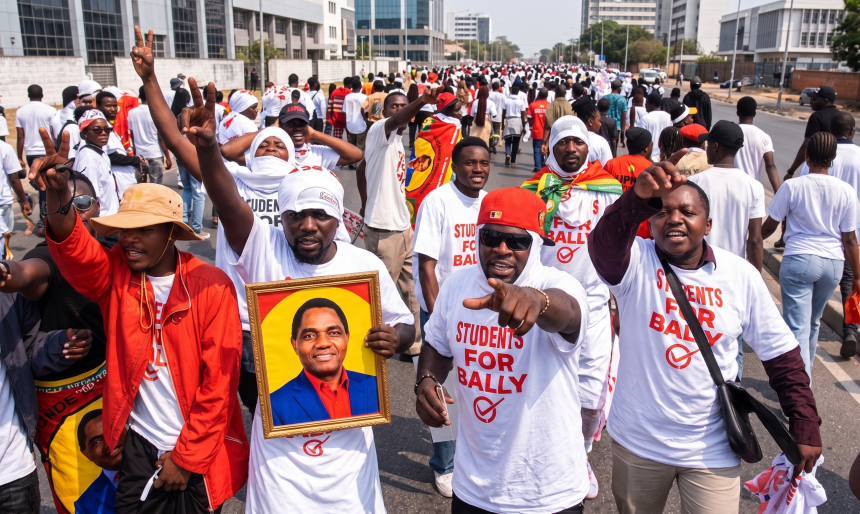
In a significant show of political force, tens of thousands of citizens converged on Lusaka for President Hakainde Hichilema’s final campaign rally before Thursday’s presidential vote. The incumbent seeks a second mandate against a backdrop of complex economic challenges, including high living costs and unemployment, while facing pointed allegations regarding the treatment of opposition figures.
Supporters of the governing United Party for National Development (UPND), characterized by their distinctive red attire and vibrant party banners, saturated a former opposition stronghold south of the capital. The event served as a strategic effort by the Hichilema administration to consolidate and energize its core constituency in the final hours of the campaign cycle.
The 64-year-old President, whose 2021 victory was seen as a landmark moment for Zambian democracy, passionately lobbied for a continuation of his policy agenda. He emphasized that the upcoming election is a critical juncture for the nation’s developmental trajectory.
“Have you reaffirmed your commitment to the UPND vision?” Hichilema inquired of the massive crowd. During his address, he highlighted his administration’s key successes, specifically citing the expansion of free primary and secondary education alongside the significant recruitment of healthcare professionals and educators to the public sector.
As the leader of a copper-dependent nation of 22 million people, Hichilema is campaigning on a platform of fiscal discipline and institutional reform, hoping to secure another five-year term to complete his economic turnaround strategy.
Jobs and living costs dominate
The discourse surrounding this election is heavily dominated by economic pragmatism, with job creation and inflationary pressures remaining the primary anxieties for the electorate.

While official statistics place the national unemployment rate at approximately 10 percent, underemployment remains a pervasive issue. Hichilema has earned international accolades for successfully restructuring Zambia’s debt and steering the economy back toward a projected five percent growth rate this year; however, the domestic impact of these macroeconomic gains remains a subject of intense debate.
Critics and opposition leaders argue that the statistical recovery has failed to manifest as tangible improvements in the daily lives of average Zambian households, where the cost of essential goods continues to strain family budgets.
The urgency of these issues was palpable at the rally, where unemployed graduates from the nursing and teaching sectors advocated for more robust public hiring programs, underscoring the high expectations placed on the government by the country’s youth.
Supporters praise stability
Proponents of the Hichilema administration contend that the greatest achievement of the last three years has been the restoration of civil order and the reduction of political volatility that marked previous eras.

Brian Mpande, a dedicated UPND supporter, emphasized that social harmony is the President’s most vital contribution to the nation.
“For the first time in many years, there is a genuine sense of peace in our communities,” Mpande remarked, suggesting that for many, the intangible benefit of political stability outweighs immediate financial grievances.
Sandra Simwale, an educator, echoed this sentiment, noting that the ability to conduct business and attend public gatherings without fear of state-sponsored disruption is a testament to the current administration’s commitment to democratic norms.
Incumbent warns against opposition
President Hichilema has framed the election as a fundamental choice between his structured governance and a return to the governance style of the Patriotic Front (PF), which he associates with systemic instability.
He cautioned the electorate that an opposition mandate could potentially revive “regressive habits” from the past, invoking concerns about a resurgence of political violence and institutional fragility.
Furthermore, the President has leaned heavily on the successful implementation of his free education policy as a cornerstone of his first-term legacy.
“Our support for HH remains firm because he made schooling accessible for all children. This is an investment in our future,” stated 29-year-old voter Anna Chewa in a recent interview.
Challenger raises alarm
Conversely, the primary challenger, Brian Mundubile, has raised serious alarms regarding the narrowing of political space, accusing the state of employing arrests and abductions to neutralize opposition activity.
Mundubile, a former provincial minister, claimed that several opposition figures have disappeared, suggesting that extrajudicial detentions may be occurring to stifle dissent.
His allegations extend to the media and creative sectors, where he claims journalists, artists, and digital influencers have been targeted for their critical perspectives on current government policies.
“The integrity of this election is at risk if it is conducted in an atmosphere of fear and intimidation,” Mundubile asserted during a recent press conference.
The government has not been cited in the provided material as responding to the specific allegations.
New challenger disrupts race
While Hichilema was initially favored for a comfortable re-election, Mundubile’s late entry into the race in May, backed by a coalition of smaller parties, has introduced a new level of uncertainty into the contest.
A prominent attorney, Mundubile has attempted to mobilize a nationwide campaign in a remarkably short timeframe under the banner of the newly established NRPUP party.
Following violent clashes and the deployment of tear gas by law enforcement at several early physical rallies, Mundubile transitioned his strategy primarily toward digital platforms to circumvent physical restrictions and security risks.
In addition to the two frontrunners, twelve other candidates—including a former foreign minister—are on the ballot, though they are largely viewed as peripheral to the main contest between the UPND and the NRPUP coalition.
Zambia awaits Thursday’s vote
This election serves as a referendum on the Hichilema administration’s ability to transform macroeconomic stability into broad-based prosperity, particularly as Zambia seeks to leverage its copper resources in the global transition to green energy.
As the nation prepares to vote, the balance between economic recovery, employment opportunities, and the preservation of democratic freedoms remains the central tension. The outcome will decide whether the Zambian electorate prefers the continuity of the current reformist path or a shift toward a new political alternative.
The political atmosphere heading into this election is characterized by a sophisticated yet tense polarization. While the Hichilema administration has successfully project a veneer of international respectability and fiscal responsibility, the domestic landscape is increasingly fractured by narratives of ‘law and order’ versus ‘democratic backsliding.’ The shift of opposition campaigning to digital spheres highlights a modern adaptation to perceived physical restrictions, suggesting that the battlefield for Zambian hearts and minds has moved from the streets of Lusaka to the smartphones of its youth.
Economically, the “New Dawn” promised by Hichilema in 2021 faces its harshest test at the kitchen table. For the average Zambian, the technical triumph of debt restructuring and inflation control is often obscured by the daily reality of stagnant wages and the high cost of fuel and maize. The ‘macro-micro’ gap—where a country’s balance sheets look healthy while its citizens’ pockets remain empty—is the most significant hurdle for the incumbent, as voters weigh the long-term benefits of structural reform against the immediate need for relief.
Ultimately, the state of democracy in this election process remains in a delicate equilibrium. Zambia has a long-standing reputation for peaceful power transfers, yet the allegations of abductions and the use of law enforcement to break up opposition rallies have cast a shadow over the proceedings. The true indicator of Zambia’s democratic health will not just be the peaceful nature of Thursday’s vote, but the post-election environment—specifically how the state handles dissent and whether it upholds the very freedoms that many supporters claim have been the hallmark of Hichilema’s first term.