






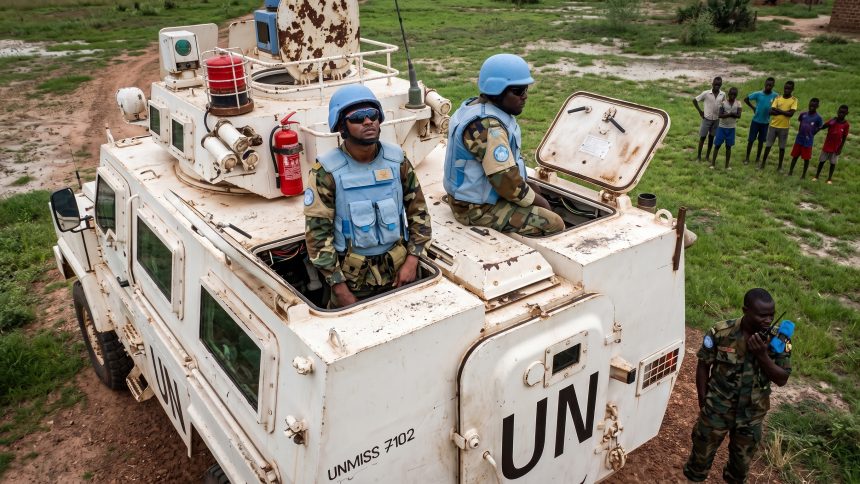
ABIEMNHOM / BENTIU, South Sudan — Reevaluating key operational plans in light of escalating security and climate threats, the United Nations Mission in South Sudan (UNMISS) has deferred the closure of a critical military base in Unity State to safeguard vulnerable local populations.
The strategic shift follows a devastating surprise assault on the remote town of Abiemnhom on March 1, 2026, when heavy gunfire shattered the early morning calm. Thousands of fleeing residents sought emergency shelter with Mongolian peacekeepers, who opened their gates to provide immediate armed protection and life-saving medical care to dozens of injured civilians.
Thousands fled to the United Nations base, seeking refuge with Mongolian peacekeepers who immediately opened the gates of their temporary base, providing protection and medical treatment to dozens of injured.
Months after attackers torched crops and looted homes, displaced families remain in precarious conditions, rebuilding amid persistent fears of renewed intercommunal clashes.
Despite tightening budgetary constraints, UNMISS suspended plans to decommission the outpost. Peacekeepers have intensified robust armed patrols, deepened engagement with local leaders, and reinforced grassroots peace and reconciliation initiatives to deter further hostility.
“In Abiemnhom, communities were deeply concerned that our departure would leave them exposed and vulnerable,” said Anita Kiki Gbeho, Special Representative of the Secretary-General and Head of UNMISS. “I assured them that under our mandate to protect civilians, UNMISS will stand with the people of Abiemnhom while supporting sustainable, community-led solutions to resolve this conflict.”


Compounding Emergency: The Looming Flood Crisis
During an extensive field assessment across Unity State, Gbeho met with local authorities, displaced community groups, and frontline peacekeepers to evaluate the converging humanitarian challenges.
Beyond active conflict, Unity State faces severe environmental jeopardy as the approaching rainy season threatens to trigger historic flooding, compounding an already critical humanitarian crisis.
“The area faces complex, overlapping risks—from localized violence to alarming water accumulation around Bentiu,” Gbeho highlighted. “With predictions indicating a potential super El Niño cycle, we face the dual threat of severe drought and severe flooding.”
The region has remained partially submerged since unprecedented floods inundated Unity State in 2019, isolating Bentiu behind thousands of square kilometers of standing water.


With seasonal rains accumulating annually, water levels have steadily risen, pushing existing containment infrastructure to its limits.
Anticipated water surges place unprecedented stress on the extensive dike network constructed and maintained by UNMISS military engineers and humanitarian agencies, which currently shelters hundreds of thousands of displaced individuals and host community members.
“Mitigating these floodwaters is our single greatest obstacle because residents are entirely exposed,” noted Nyier Gatchang Pouch, Chairperson of the Community High Committee in the Bentiu displacement camp. “Without direct intervention from UNMISS and government authorities, local populations lack the means to stem the water flow.”
Urgent Infrastructure Demands and the Path Ahead
Community leaders are urging government authorities to lead efforts in structural dike repairs, drainage optimization, and the establishment of disaster evacuation corridors before floodwaters peak.
“Residents cannot manage this scale of defense independently; we simply do not possess the heavy equipment required to build effective dikes against water levels of this magnitude,” Pouch added.
Despite operational difficulties, UNMISS maintains its active posture in Unity State, combining defensive infrastructure support with proactive peacebuilding initiatives.
Reflecting on the mission’s dual focus, Gbeho emphasized that lasting stability depends on addressing root causes: “When navigating this complex web of security and climate crises, one fundamental truth remains—peace is the indispensable foundation for any long-term solution.”