





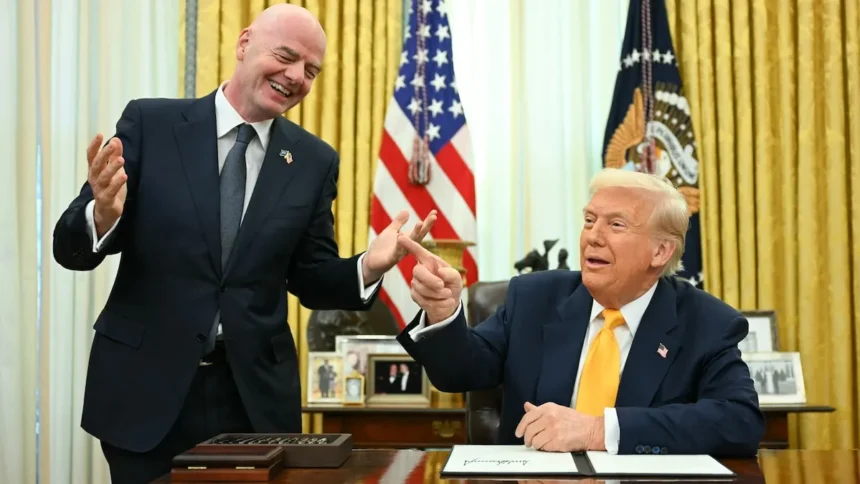
US President Donald Trump has stated that while Iran’s men’s national football team is “welcome” at the 2026 World Cup, he believes their presence is not “appropriate” given the current safety risks. The tournament is set to be hosted by the United States, Canada, and Mexico, beginning on 11 June.
Geopolitical Tensions Overshadow Iran’s 2026 World Cup Participation
The approach of the 2026 FIFA World Cup, set to be co-hosted by the United States, Canada, and Mexico, has been overshadowed by significant geopolitical tensions concerning the participation of the Iranian men’s national football team. The controversy stems from heightened security risks following recent military and political clashes in the Middle East. Trump’s Concerns and Security Assessment

On Thursday, former US President Donald Trump weighed in on the matter via a post on his social media platform, Truth Social. While acknowledging that Iran’s national team is “welcome” at the tournament, which is scheduled to kick off on 11 June, Trump expressed a strong reservation. He stated his belief that their presence is currently “not appropriate” given the volatile security situation. This commentary highlights the complexity of hosting a global event amidst such diplomatic friction, particularly one involving a nation with severely strained relations with the host country. Iran’s Official Stance on Withdrawal
Trump’s remarks followed a direct and unequivocal statement from Iran’s Minister of Sports and Youth, Ahmad Donyamali. Speaking to the IRIB Sports Network on Tuesday, Donyamali indicated that Iran was leaning toward withdrawal. He asserted that the necessary conditions for participation did not exist, stating that Iran was “not in a position to participate” because the environment was not “appropriate.”
The Minister directly linked this decision to the recent, devastating assassination of the country’s supreme leader, Ayatollah Ali Khamenei, which he attributed to the actions of the “corrupt government”—a clear reference to the US and Israel. Donyamali emphasized the immediate safety concerns, dramatically stating, “Our boys are not safe, and conditions for participation do not exist.” This suggests that the government views the host nations, particularly the United States, as unable or unwilling to guarantee the safety of its athletes. Conflicting Diplomatic Signals

The public statements from both sides contrast with prior assurances given to FIFA. FIFA President Gianni Infantino had previously indicated that he had received personal confirmation from President Trump that Iran was “welcome to compete” at the finals, suggesting an earlier diplomatic consensus that has now clearly deteriorated. The current public dispute underscores the deep political fissures that are now complicating the logistics of the international competition. The Immediate Cause of Instability
The primary catalyst for this uncertainty is the dangerous escalation in the Middle East following the fatal US and Israeli strikes on the Iranian Supreme Leader. Iran swiftly retaliated, launching missiles and drones that targeted Israeli territory, as well as military facilities in four key Gulf Arab countries hosting US forces: Bahrain, Kuwait, Qatar, and the United Arab Emirates. This series of retaliatory attacks has significantly raised the threat level in the region and, by extension, has influenced the perception of safety for Iranian nationals abroad. World Cup Schedule and FIFA’s Next Steps
Iran’s national team had been officially scheduled for three group stage matches in the United States:
- 15 June: vs. New Zealand in Los Angeles
- 21 June: vs. Belgium in Los Angeles
- 26 June: vs. Egypt in Seattle
Should Iran follow through on its threat to withdraw—which would prematurely end what would have been the country’s fourth consecutive World Cup appearance—FIFA regulations would come into effect. The governing body holds the discretion to select a replacement team to fill the vacated spot. However, as of now, FIFA has not named or indicated a specific replacement team, likely holding out hope for a last-minute reversal of Iran’s position. The international football community now awaits a definitive decision from Tehran, which could profoundly impact the tournament draw and schedule.


It’s interesting to see how geopolitical tensions are shaping the conversation around the 2026 World Cup, especially given the host countries’ involvement. Trump’s comments highlight the complex intersection of sports and politics, and it will be worth watching how FIFA and the involved nations navigate these concerns while ensuring player and fan safety. Hopefully, the focus can ultimately remain on the sport itself.