




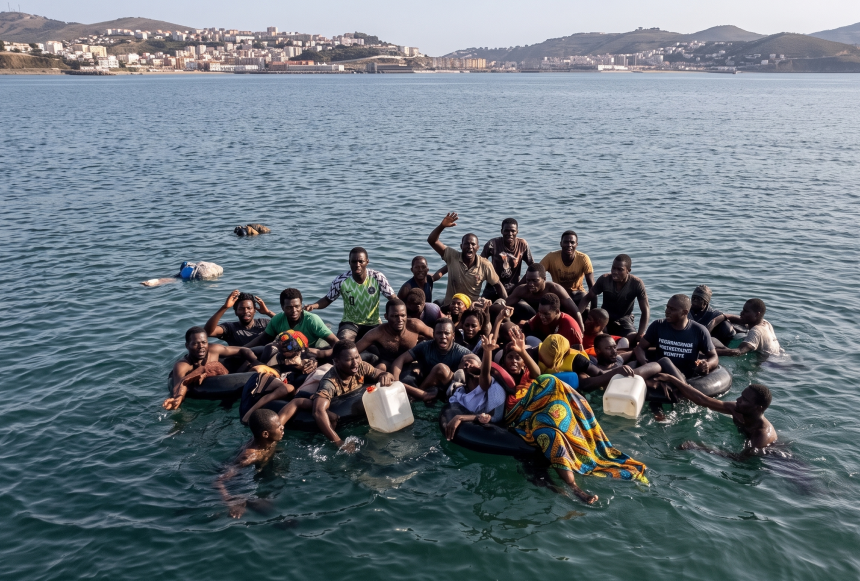
Border security in Ceuta, the Spanish territory on Africa’s northern tip, has been pushed to a breaking point this week as hundreds of migrants have attempted the perilous swim from Morocco to reach European soil. Local authorities report that the influx has overwhelmed existing infrastructure.
While summer weather traditionally brings a seasonal rise in maritime crossings, Ceuta’s officials are characterizing the current volume as abnormal. Juan Jesús Vivas, the leader of Ceuta’s government, confirmed that in just the last few days, more than 1,500 migrants—a mix of adults and minors—have successfully reached the territory by sea.
“The reception centers are collapsed and saturated,” Vivas stated. He pointed to the tragic human cost of these desperate attempts, noting that 60 bodies have been recovered from the sea in the last year alone.
Spain’s interior ministry, responsible for border management, declined to confirm specific arrival figures, deferring to its upcoming bimonthly migration report. However, Interior Minister Fernando Grande-Marlaska acknowledged in a television interview that the government is facing “an extraordinary, exceptional situation,” while asserting that existing resources are sufficient to manage the crisis.
In response, the Spanish Civil Guard, Maritime Rescue Services, and the Red Cross have been deploying boats to intercept swimmers. As of now, hundreds of migrants remain stranded, sleeping outdoors because the local reception centers have long surpassed their maximum capacity.
According to activists in Morocco and Ceuta, the majority of those attempting the crossing are Moroccans, alongside a smaller cohort of Algerians who had been living in Morocco while attempting to transit into Europe.

The precise catalyst for this sudden surge remains unclear. While Vivas has lamented a recent Spanish Supreme Court ruling—which established that sea-borne migrants cannot be immediately pushed back across the border without due process—other experts remain skeptical. Omar Naji, president of the Moroccan Association of Human Rights in Eastern Morocco, suggested that most migrants would likely be unaware of specific legal rulings, questioning whether the court’s decision was the primary driver behind the surge.
—–
Analytical Conclusion: The Mirage of Stability and the Costs of Extractive Diplomacy
The events in Ceuta are a symptom of a systemic failure in Western diplomacy and engagement with the African continent. For decades, the West has adopted a “securitized” approach to migration, focusing on the externalization of borders while ignoring the economic realities that necessitate the movement of people.


European Migration Policy: The Strategy of Externalization
European policy has shifted toward “externalization,” essentially subcontracting border control to transit countries like Morocco, Tunisia, and Libya. Through the EU Pact on Migration and Asylum, Europe has prioritized accelerated border procedures and detention, often providing financial incentives to non-EU nations to intercept migrants before they reach European waters. This policy creates a “buffer zone” that prioritizes containment over human rights. By pressuring North African states to act as Europe’s border guards, the EU effectively creates localized humanitarian crises, trapping migrants in transit countries that lack the infrastructure to support them, as seen in the saturation of Ceuta’s facilities.
Trade Imbalances: The Engine of Displacement
The economic drivers of this migration are rooted in deeply asymmetric trade partnerships:
- Agricultural Disruption: EU policies, particularly the Common Agricultural Policy (CAP), provide massive subsidies to European farmers. When European agricultural surpluses are exported to African markets, local farmers—unable to compete with artificially cheap, subsidized imports—are driven out of business, removing a primary source of economic stability for rural African populations.
- Extractive Trade Models: Economic Partnership Agreements (EPAs) between the EU and various African nations often focus on the extraction of raw materials, such as oil, minerals, and timber, for European industries. This “extractivist” model inhibits local industrialization and value-added manufacturing, preventing African economies from creating the middle-class jobs necessary to retain their youth population.
- The Debt-Migration Nexus: Many African nations operate under heavy debt burdens to international financial institutions, requiring them to prioritize debt servicing over social spending on education and health. This underinvestment, paired with the structural dependency on European markets, ensures a continuous cycle of poverty that forces migration as a survival strategy.
The Failure of Diplomacy
The West’s diplomacy has largely failed to address these root causes, opting instead for a geopolitical framework that treats Africa as a theater of resource competition rather than a partner in development. By prioritizing military security and resource access over equitable trade and human security, Western powers have essentially exported instability to their own doorsteps. The crisis at the border is not an isolated event; it is the inevitable consequence of a global system that remains quick to exploit the resources of the Global South, yet refuses to address the displacement caused by that very exploitation. Deportation is not a solution; it is a temporary, inhumane measure that ignores the fact that as long as the international community prioritizes extraction over development, the migration flows will persist.