





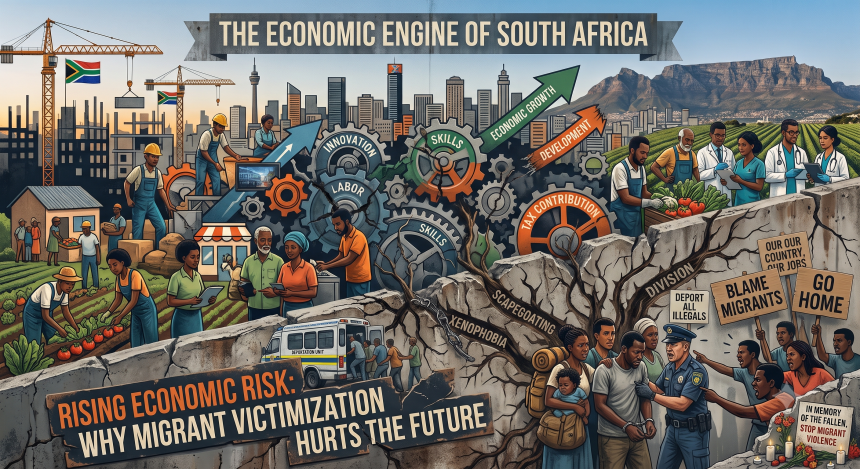
The current anti-immigrant surge is not just a social crisis; it is a profound act of economic self-sabotage. While political rhetoric positions migrants as the primary cause of South Africa’s 30-plus percent unemployment rate, the data tells a far more nuanced and critical story about the country’s growth potential. The Hidden Engine of Growth
South Africa’s service and adventure tourism sectors serve as a vital case study. By 2024, the adventure tourism industry alone generated over $656 million in direct revenue and supported an estimated 91,000 jobs nationwide.
This sector is not an isolated bubble; it relies on a diverse, mobile, and often migrant-inclusive workforce that sustains supply chains in rural and underserved areas. When businesses shutter due to fear or intimidation, these jobs do not simply transition to local workers. They evaporate. The economic “multiplier effect”—where migrant spending and labor ripple through local communities—is being actively dismantled.The Myth of the “Job Stealer”
The loudest political narratives rely on a distorted arithmetic. Migrants constitute less than 4% of the total South African population. Attributing chronic, structural unemployment—which has roots in education gaps, historical inequality, and systemic governance failure—to such a small demographic is not just factually flawed; it is a dangerous deflection.
Scapegoating provides a convenient, visible target for public frustration, but it ignores the reality that migrants often fill critical gaps in the informal economy and small-to-medium enterprise sectors where local labor may be unavailable or disconnected from market needs.The “Xenophobia Tax”
Xenophobia functions as an unofficial, punitive tax on growth.


- Business Disruption: Forced shop closures and the expulsion of traders disrupt local supply chains, leading to higher costs for consumers and lower tax revenue for municipalities.
- Investor Confidence: Global capital markets demand stability. Escalating vigilante violence signals a nation unable to manage its own internal conflicts, prompting investors to seek more predictable markets elsewhere.
- Global Isolation: As South Africa positions itself as a leader in global mineral and energy partnerships, its internal volatility undermines its diplomatic leverage.
The Road Ahead
South Africa stands at a crossroads. It can continue to burn its own economic bridges, fueled by a narrative that blames the vulnerable for the failings of the powerful. Or, it can recognize that sustainable growth requires an inclusive labor market that leverages, rather than expels, the talent within its borders.
If South Africa wants to solve its unemployment crisis, it must address the “disease”—stagnant governance and educational disparities—rather than attacking the symptoms. Otherwise, the “xenophobia tax” will continue to erode the very future the country is desperate to secure.