





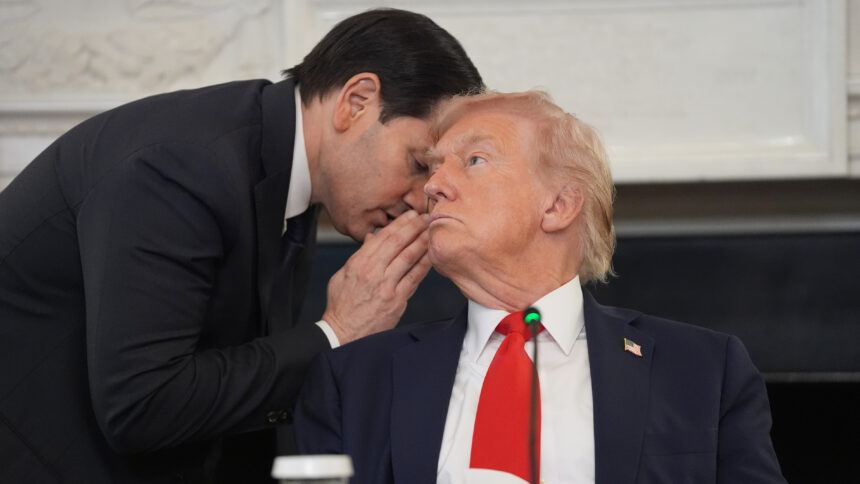
President Donald Trump announced a five-day postponement of threatened military strikes against Iranian power plants on Monday, just hours before his deadline for Tehran to reopen the vital Strait of Hormuz shipping route. Trump cited “productive” talks with Iran toward a “complete and total” resolution of the ongoing war, a stunning shift announced on his social media account.
However, Iran’s Foreign Affairs Ministry swiftly denied any direct dialogue with Washington. In a statement via the semiofficial Mehr News agency, the ministry suggested Trump’s delay was a tactic “to reduce energy prices and buy time to implement his military plans,” though it acknowledged “initiatives from regional countries to reduce tensions.” Iranian state media claimed Trump “backed down” following Iran’s vow of swift retaliation for any strikes on its energy infrastructure.
This reversal delays what many feared would be a significant new escalation in the nearly month-long conflict that has consumed the Middle East, driven up energy and food prices, and threatened the global economy.

Despite Trump’s move, markets’ positive response was quickly followed by a new round of Israeli strikes in Tehran, indicating the broader war—launched by the U.S. and Israel on Feb. 28—continues, as does Iran’s effective closure of the Strait of Hormuz.
The ongoing disruption to global shipping in the Strait of Hormuz—through which around 20% of the world’s oil passes—has created an energy crisis worse than the combined impact of the 1970s oil shocks and the war in Ukraine, warned International Energy Agency Executive Director Fatih Birol. Oil prices have globally rocketed, with U.S. crude up over 70% this year and retail gas prices rising 93 cents per gallon.

Trump had initially given Iran 48 hours on Saturday to reopen the strait, threatening to bomb power plants via a Truth Social post. Iranian officials, however, had remained defiant, threatening to strike electricity targets across the Persian Gulf, including plants supplying drinking water, and to close and mine the Gulf if faced with a coastal invasion. Iran has shown no sign of capitulating despite the killings of its supreme leader and other senior officials.

Speaking in West Palm Beach, Florida, Trump told reporters that Iran had initiated contact in a bid to “make a deal” and diplomatically end the war. He mentioned 15 discussion points, including Iran’s permanent inability to obtain a nuclear weapon, stating, “There’s got to be a good deal, and it’s got to be no more wars, no more nuclear weapons.” He added that Israel would be “very happy” with such a deal and identified his special envoy, Steve Witkoff, and son-in-law Jared Kushner as leading the talks, without naming the Iranian contacts.
Rhetoric had escalated over the weekend. On NBC News’ “Meet the Press,” Treasury Secretary Scott Bessent suggested the U.S. approach was “not mutually exclusive,” stating, “Sometimes you have to escalate to de-escalate.” Bessent also warned that “all options,” including deploying troops, were on the table to secure Kharg Island—a critical Iranian oil hub bombed by the U.S. last week.
Experts caution that the sudden shift is difficult to interpret. Ross Harrison, a senior fellow at the Middle East Institute, suggested the move could be an “off-ramp to completely de-escalate and end this conflict,” or, as Iran’s ministry suggested, “it could be a trap,” with Trump using the time to prepare expanded U.S. operations. The ultimate meaning of this dramatic turn and the details of any agreements remain unclear.